
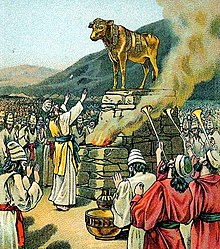
Exodus 32 gives us an account that should be chilling to the Christian. Moses has gone up to Mt. Sinai (chapter 24-31) to receive the Torah from Adonai. He remained on the mountain for 40 days and 40 nights. While on the mountain, Moses charged Aaron and Hur with handling the affairs and questions of the people.
In Moses’ absence, the people began to grow impatient. They began to murmur. Likely, they believed he had died on the mountain. But they knew he had been in the presence of Adonai, for at the beginning of the ascent, the mountain had been veiled in smoke for 7 days, out of which Adonai spoke to Moses. This was not dissimilar to Exodus 19 when Moses had earlier ascended the same mountain, was enveloped in smoke, and received the Torah, including the 10 Commandments (Chapter 20). But at some point, in this second occurrence, they lost faith that he would return.
And when the people saw that Moses delayed coming down out of the mount, the people gathered themselves together unto Aaron, and said unto him, Up, make us gods, which shall go before us; for as for this Moses, the man that brought us up out of the land of Egypt, we wot not what is become of him.
Exodus 32:1, KJV
Now, some would say forty days is a long time, and anyone would eventually have to give up on his returning and leave him for dead. This may be true in many instances, but a closer look at the text indicates they lost hope much earlier than that. Skipping down to verse 4, we see that Aaron melted down the jewelry of the Hebrews and fashioned it with a graving tool into a sculpture of a calf and the people (presumably the elders) said, “these be thy gods, O Israel, which brought thee up out of the land of Egypt.” I do not know how long it would have taken Aaron to carve a sculpture of gold, but I take the assumption that he was not a skilled sculptor. Perhaps carving sculptures was his job as a slave in Egypt, but notwithstanding, there is nothing that points to this fact in Scripture. Nevertheless, he would not have been likely to carve out a golden calf overnight. This task would likely have taken several days or weeks, depending on the size of the idol. The significance of this is that the people lost faith in Moses, and Adonai, very early in his mission. It is probable, according to this timeline, that the golden calf incident occurred during Moses’ first week on the mountain.
Failures of the Elders
The second significant part of this incident is the failure of the elders. As we see in chapter 24:14, Moses left the elders at the base of the mountain. They were to lead the people in his absence, and the elders would in turn go to Aaron and Hur for weightier matters. When the people began to grow restless, the scripture does not record the elders standing in the gap. Instead, it says “the people,” which we can assume included the elders, went to Aaron and demanded a graven idol. So quickly the Hebrews went from Chapter 24:3 where they declared “all the words which Adonai hath said will we do!” to “up, make us gods!” And the elders did nothing. In fact, they caved to the pressure of the congregation. I am reminded that the Hebrews were only mere weeks outside of leaving a pagan culture where they had been for 430 years. There was a lot of superstition, tradition, and false notions about deities, be they false or the one true God, Adonai. But the elders were their leaders; men of high esteem and pious character who were their judges, patriarchs, and one could say, pastors. But they, too, were steeped in false beliefs that crept in during this time of trial, and rather than stay strong, they buckled, as did Aaron. The one who Adonai was declaring to Moses at that very time to be the first high priest failed in pointing the crowd to the Almighty and instead had the people turn in their jewelry (vanity, pride, originating with the heathen Egyptians) and used it to fashion a graven image in the form of a calf. What’s worse is they then declared (verse 4), “these be thy gods!” In one fell swoop, the Hebrews, led by the newly minted high priest, violated the first 3 commandments. Let’s recap what those are:
I am Adonai your God, who brought you out of the land of Egypt, out of the abode of slavery. ב “You are to have no other gods before me. You are not to make for yourselves a carved image or any kind of representation of anything in heaven above, on the earth beneath or in the water below the shoreline. You are not to bow down to them or serve them; for I, Adonai your God, am a jealous God, punishing the children for the sins of the parents to the third and fourth generation of those who hate me, but displaying grace to the thousandth generation of those who love me and obey my mitzvot. ג“You are not to use lightly the name of Adonai your God, because Adonai will not leave unpunished someone who uses his name lightly.
Exodus 20:2-7, Complete Jewish Bible
Notice the preface to the Commandments is, “I am Adonai your God, who brought you out of the land of Egypt,” yet the Hebrews immediately declare the same of the golden calf. They are violating the commandment to not create a graven image, but in so doing they are calling the same image Adonai, the one who delivered them. This is a violation of the commandment to not use His name in vain (lightly). This is reiterated in verses 5-6,
On seeing this, Aharon built an altar in front of it and proclaimed, “Tomorrow is to be a feast for Adonai.” Early the next morning they got up and offered burnt offerings and presented peace offerings. Afterwards, the people sat down to eat and drink; then they got up to indulge in revelry.
Exodus 32:5-6, CJB
So Aaron then built an altar, declared the next day to be a feast to Adonai, and then the people brought offerings (as commanded previously in Torah) to Him. In essence, they violated Torah, called the violation an iteration of Adonai, then sacrificed to the violation and worshipped it, all while calling it the image of Adonai. How discombobulated can you be?
We are no better than the Hebrews
Lest you grow unjustly critical of the Hebrews, let me point out that modern Christians are guilty of the exact same sins.
If I had a dollar for every time I’ve heard someone say, “my God would never…” or “Jesus would never…” I would be significantly better off financially. Or on the other hand, many people attribute doctrine or happenstance to the will or word of Adonai. “God told me,” or, “I believe,” are no substitute for what His actual Word says. What about when we take the Word to justify our sin or false belief? Just as the Hebrews took the word of Adonai and applied it to the idol, so are we often guilty of taking the Word and using it to fuel our heart’s depiction of Him.
Believer, you have been chosen by God and called out of your Egypt. You have been saved from the sins of the heathen, but do not use this as an opportunity to bring those sins with you and call them holy! Your traditions and previous beliefs are a weight you need to shed. They should have been cast off in the sea when you passed through unto a new life, but we all bring something with us. The time to cast them away is now. This is not to say that everything from the past is unfit for a follower of Adonai. The Hebrews had been commanded by Adonai to receive jewelry, riches, and clothing from their Egyptian neighbors when they left their captivity. He meant to use the riches of the heathen for a new purpose: to fashion the basins, ark, candlesticks, and other furniture in the tabernacle that was to come. The talents, passions, and faith that we bring from our old life can be used for His glory, but that is for Him to do a work within us and not for us to use to define who He is in our own deceitful hearts.
The heart is deceitful above all things, and desperately wicked: who can know it?
Jeremiah 17:9, KJV
Elders beware!
Preachers, we must be careful that we also do not bring our own traditions and past experiences into our exposition of the Word and Will of God! We are part of “the people” even though we are called to lead and teach them. We are no less susceptible to following our own designs when seeking to worship and follow the Almighty. The danger comes when we break the law of God and encourage others to follow us in so doing. Matthew 5:19 gives us a grave warning:
Whosoever therefore shall break one of these least commandments, and shall teach men so, he shall be called the least in the kingdom of heaven: but whosoever shall do and teach them, the same shall be called great in the kingdom of heaven.
Matthew 5:19, KJV
If using the Lord’s name in vain (as in swearing) is terrible, how much more so is attributing His name to something He never did? Did God really declare righteous what you say is righteous, or are you attributing His name to your opinion or prejudice? Is something you call evil what He would call evil, or are you applying your own experiences or societal norms to a practice or activity? In doing this, is this considered one of the “least commandments,” or is using His name in vain a great commandment?
Furthermore, we must resist the temptation to not speak the truth for fear of the mob. Sometimes it is easy to “take the high road,” and live in silence on a matter to keep the peace or avoid division, but what did Christ do? Along with His declaration that He did not come to abolish the Torah, He also stated that He came to divide.
Suppose ye that I am come to give peace on earth? I tell you, Nay; but rather division:
Luke 12:51, KJV
He obviously did not mean that He was cause for strife and division within the body of believers, but that He would be a cause for division among those who held to the world and those who embraced Him. He also reminded us that we cannot serve two masters (Matthew 6:24, Luke 16:13). Traditions alone are not wrong, but when they dictate how we worship Him, they become a master and we are slaves to our past. In this case, we must cast off Egypt and worship Adonai, free from the bondage of our traditions. And we cannot allow the opinions and traditions of others to cause us to disregard this requirement. We will not stand guiltless if we teach people to disregard any portion of God’s word because it is outdated, not applicable, or if we conflate His word with our tradition. How sobering is this reminder!
I come in love, not condemnation
As usual, I do not bring this word as a condemnation, but a plea. Many in our churches are in bondage, not to gross wickedness or unrighteousness, but in adherence to false attributions to God. If God says it, do it! If He says not to, don’t do it! Sola scriptura is not only for the reformers; indeed, all Christians should lean not on their (or a teacher’s) own understanding, but on the Scriptures alone. How many have fallen away from the Truth because they were taught a truth that was false? How many have worshipped a graven image that they were told was Adonai? How many times have we been instructed, or instructed others, to follow such and such a belief that was contrary to the true Word of God?
Christian, whether you are “the people” or “the elders,” please remember this account of the golden calf and ask in prayer, “am I following a golden calf of my own design or the Adonai of the mountain?”
 The Objective Perspective