
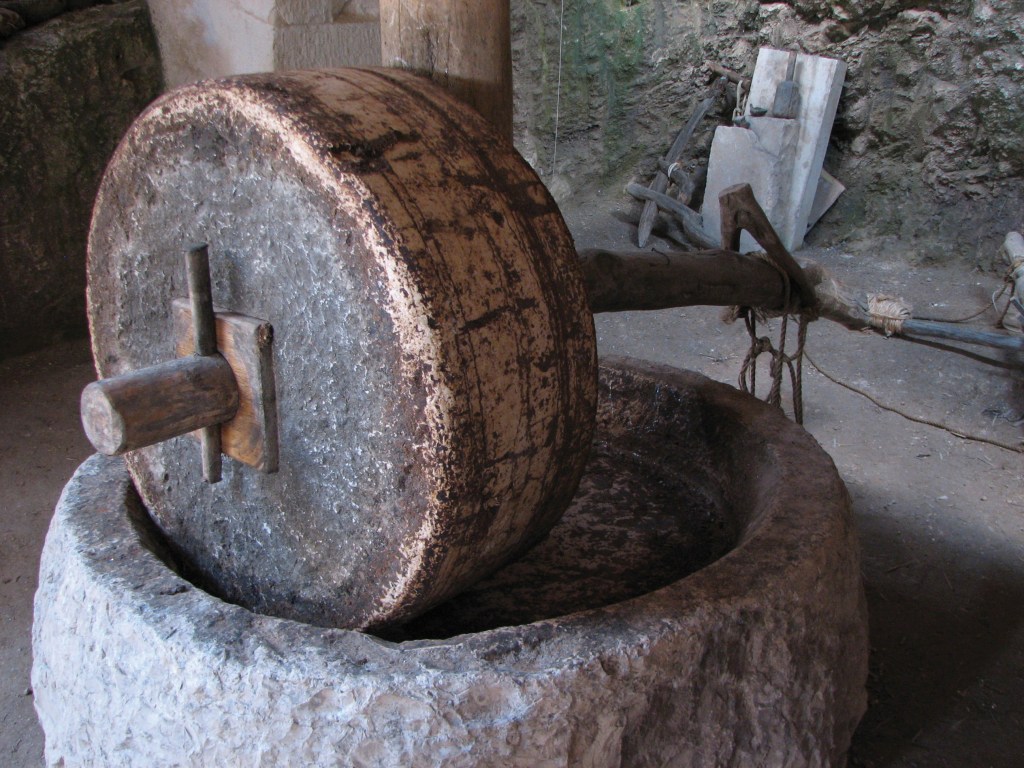
But whoso shall offend one of these little ones which believe in me, it were better for him that a millstone were hanged about his neck, and that he were drowned in the depth of the sea. – Matthew 18:6
This famous quote from the mouth of Messiah is often quoted as proof of the appropriate punishment for those who abuse children. While I would disagree, as this punishment seems far too lenient on someone who would hurt a child, the true meaning of this passage is much more chilling than that, for it speaks not to the molester, but to each and every one of us. This is actually quite obvious at first glance, especially if read in context with the previous verses in the chapter. Because I believe we all have a duty to study the Scripture for what it actually says and not what popular culture or church tradition has taught us, I decided to dig into the passage to get to the bottom of it.
Some will say that any teacher/preacher that has to go to the Greek (or Hebrew) to expound on the Scriptures isn’t a very good practitioner of their calling. That may well be true, but I have found that in my personal studies, going to the original languages to understand original intent is not only wise, but necessary. The reader may wonder why that is so, and I will briefly explain why. No copy of the Scriptures existed in English until roughly mid-16th century. By this time, Greek had ceased to be the language of the known world, and while the translators of the Scriptures had a vast knowledge of the old languages, they were not infallible. These men were not steeped in Greek thought or culture, let alone Hebraic patterns of speech and thought. I have no doubt they did their best, but it is also hard to emphatically say there couldn’t have been something lost in translation. This being true, it is also true that James Strong who in 1890 indexed every word in the King James Version of the Bible in his work Strong’s Exhaustive Concordance of the Bible was not a native Greek or Hebrew speaker but was a scholar and a learned theologian. It is his work that I lean on heavily. It should be noted that “the use of Strong’s numbers does not consider figures of speech, metaphors, idioms, common phrases, cultural references, references to historical events, or alternate meanings used by those of the time period to express their thoughts in their own language at the time.” (citation)
Now fast-forward some 6 centuries, and with Western language and thought prevailing, it is easy for the modern reader to project modern thought and intent into the ancient writings. I do not claim to be any kind of scholar of the ancient languages, but how many of the people preaching or teaching can say that they are, and be truthful in so doing? However, I do possess study helps, written by scholars, and this helps me to get a better understanding of the meaning of the Scriptures. These study helps are available to anyone in the English-speaking world, so it is easy for the reader to verify what I write. By using this method of study, I do not hobble myself with tradition or man’s understanding, which I believe is vital to fully understanding the Scriptures in the way Yahweh intended.
First, let us focus on two key words found in this passage: offend and little ones
Offend
σκανδαλίζω skandalízō, skan-dal-id’-zo; from G4625; to entrap, i.e. trip up (figuratively, stumble (transitively) or entice to sin, apostasy or displeasure):—(make to) offend.
Strong’s Exhaustive Concordance of the Bible, G4624
The word “offend” does not necessarily mean to abuse, either physically, emotionally, or sexually. The meaning is clear: to cause them to doubt the Word of Yahweh or their salvation. This is used in the same frame of thought as “if thy right eye offend thee, pluck it out” (Matthew 5:29). If it causes you to stray from the way or doubt your service to the One to whom you were called, get rid of it. Skandalízō is also used in Mark 4:16-17 to describe the ones who receive the Word, but wither away when the pressure is applied: “And these are they likewise which are sown on stony ground; who, when they have heard the word, immediately receive it with gladness; And have no root in themselves, and so endure but for a time: afterward, when affliction or persecution ariseth for the word’s sake, immediately they are offended.”
To be offended in this sense means to have doubt cast upon one’s faith in the Messiah. This offense can come in many forms, but to name a few: persecution, heresy, misrepresentation of the Word, being a poor example, leading pridefully (for leaders), or enticing to sin.
Little ones
μικρός mikrós, mik-ros’; apparently a primary word; small (in size, quantity, number or (figuratively) dignity):—least, less, little, small.
Strong’s Exhaustive Concordance of the Bible, G3398
This word mikrós is translated four different ways in the Scripture. In this passage, it is as the word “little.” Because of the preceding verses, many people automatically assume it means “little children,” but in actuality, that is not what it means at all. Mikrós is the same word used to describe John the Baptist (Matt. 11:11), the mustard seed (Matt. 13:13), and all who shall know Him (Heb. 8:11). It is clearly not referring to children. “Little ones” means young or small in the Lord, or new Christians, lacking in maturity and wisdom, but full of faith. Childlike faith.
But what do the preceding verses say?
“And Jesus called a little child unto him, and set him in the midst of them, And said, Verily I say unto you, Except ye be converted, and become as little children, ye shall not enter into the kingdom of heaven. Whosoever therefore shall humble himself as this little child, the same is greatest in the kingdom of heaven. And whoso shall receive one such little child in my name receiveth me.” – verses 2-5
Little child
παιδίον paidíon, pahee-dee’-on; neuter diminutive of G3816; a childling (of either sex), i.e. (properly), an infant, or (by extension) a half-grown boy or girl; figuratively, an immature Christian:—(little, young) child, damsel.
Strong’s Exhaustive Concordance of the Bible, G3813
In this case, “little child” is translated from the Greek paidíon and has an entirely different meaning than mikrós. Here, it is clearly referring to a young human being, probably pre-adolescent. Children at this age often do not question authority, but trust unwaveringly, even if they do sometimes struggle with obedience, as they learn the battle between discipline and self-will. Young children will believe all manner of things that adults tell them, and they pursue that belief with passion, even if it is false (i.e. Santa Claus). They do this because they trust and have faith in their authorities.
Yeshua is telling his disciples that unless we become like little children in our faith, we will not enter the kingdom of Yahweh. Why? Because when one looks for “adult” answers in science, logic, reason, or adherence to a creed, they lose both their capacity for faith, and their ability to see the Father.
This chapter of Matthew begins with a power play. The disciples ask Yeshua “Who is the greatest in the kingdom of heaven?” As usual, the Master responds with an illustration. He called over a little child and said, “If you don’t become like this child, who trusted me enough to come sit with me-no questions asked-you will not enter Heaven. I called, and she came to me. I reached out, and she responded. You must all have child-like faith, and when you do, it doesn’t matter who is ‘greatest’ in Heaven, because that’s not what it is all about. Furthermore, if someone does have childlike faith and comes to me, God forbid someone turns them away through deed or word. If they caused them to forsake my calling, it would have been better off that they were tied to a millstone and drowned in the sea. The punishment from the Father will be much worse.” (my paraphrase)
We should strive hard to never become hypocrites in our spiritual walk. It may well be that more people have explored church and turned away from it due to its hypocrisy and inconsistency than anything else. I know of countless individuals who attended church for a time, and even professed repentance in Christ, but have fallen away. They are like the seed that the sower planted on poor soil: some have withered away from the heat, but some were plucked away by the birds. Woe unto the believer who applies the heat (doubt) or is the bird (hypocrisy) that snatches them out of their childlike faith! Yeshua says it is better for all involved if you had died before committing that sin. That should sober us all!
 The Objective Perspective