
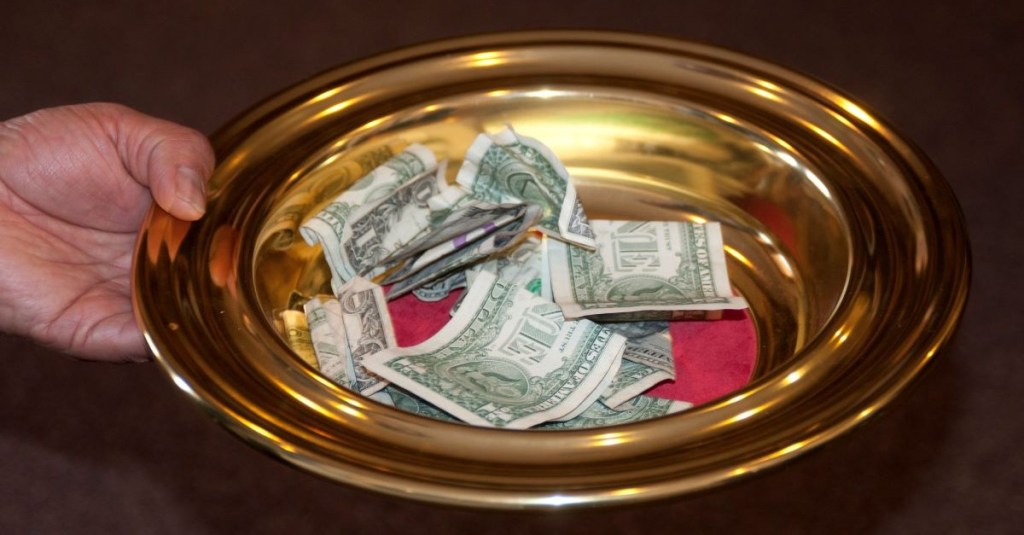
“If you don’t pay tithe, the Bible says you are robbing God and are under a curse. This curse cannot be removed by your good works or the fact you are born again. You can only reverse this curse if you start paying tithe. Tithe is the only key to prosperity and God’s blessing…Those who don’t pay tithe are robbing God because all income is from God.”
Prophet Owusu Ansa. (Ansa 2013)
The above statement is all too familiar to me, not because I heard Prophet Ansa speak it, but because I have sat through countless sermons in a half-dozen Baptist churches throughout my lifetime where this very verbiage and warning was expounded upon. I know I am not unique in hearing this, because probably the number one complaint I have heard from those who have left “the church” from a variety of denominations is that all the preacher did was ask for money, money, money. While I cannot honestly agree that money is all the preachers talk about, it is a perennial topic that gets multiple sermons devoted to it. IndependentBaptist.com echos this same charge:
“Tithing is not charitable giving. It is more understood to be a form of debt to God for giving you wealth. You can call tithe the interest or usury. You give to charities. You don’t give to the IRS or your school loan agency or your bill collectors, you owe the IRS, your school loans, and your bills. Nowhere in the Bible does the tithe ever been [sic] equated with charitable giving.”
IndependentBaptist.com, n.d.
Rather than continuing to quote men on this subject, let’s return to the source, the Word of Elohim. There are multiple references to the tithe in Scripture (thirty-two to be exact, in the KJV), and my goal is to unpack these verses in this study and see for the reader’s benefit what the Scripture says. The first verse we will look at is the most common one I’ve heard cited, and the very passage Prophet Ansa quoted in his article on tithing.
Even from the days of your fathers ye are gone away from mine ordinances, and have not kept them. Return unto me, and I will return unto you, saith the Lord of hosts. But ye said, Wherein shall we return? Will a man rob God? Yet ye have robbed me. But ye say, Wherein have we robbed thee? In tithes and offerings. Ye are cursed with a curse: for ye have robbed me, even this whole nation. Bring ye all the tithes into the storehouse, that there may be meat in mine house, and prove me now herewith, saith the Lord of hosts, if I will not open you the windows of heaven, and pour you out a blessing, that there shall not be room enough to receive it. – Malachi 3:7-10
Context is Everything
Honest and wise hermeneutics require the reader to study each verse and passage within the context of which it was written. Therefore, it is important to understand both who the aforementioned passage was written to and why it was written. From here, I would like to point the reader to Chapter 1, Verse 6. Here the Word of Yahweh Tsebaoth, through Malachi, addresses “O priests, that despise my name.” He then says, “And ye say, Wherein have we despised thy name? Ye offer polluted bread upon mine altar; and ye say, Wherein have we polluted thee? In that ye say, The table of the Lord is contemptible.” (v. 6b-7) Chapter 2 begins with the address, “And now, O ye priests,” signifying He is speaking again to the priests. Yahweh never breaks from this focus throughout the rest of Malachi’s letter. When we get to Chapter 3, Verse 8, we see again the question, “Wherein have we?” followed by Yahweh’s answer. In all of these verses, Malachi records the priests’ questions and Yahweh’s answers to them. The indictment of the priests by Yahweh reminds me of the same corruptions committed by the sons of Aaron, and later, the sons of Eli. The priests have violated and desecrated the temple as well as their ministerial positions. Nehemiah, a contemporary of Malachi, wrote about this in Chapter 13:4-5 of his letter. “And before this, Eliashib the priest, having the oversight of the chamber of the house of our God, was allied unto Tobiah: And he had prepared for him a great chamber, where aforetime they laid the meat offerings, the frankincense, and the vessels, and the tithes of the corn, the new wine, and the oil, which was commanded to be given to the Levites, and the singers, and the porters; and the offerings of the priests.” In this context, we understand the priests were robbing the storehouse of the tithes and giving them to the enemies of Judah, rather than using them in their proper manner: to maintain the house of Yahweh and to pay the wages of the laborers, musicians, and non-levitical priests.
The fact that there was even a tithe at all does prove that the people were paying a tithe, otherwise the priests could not rob it. This tithe was commanded in the Mosaic Law (Lev. 27:30; Deut. 14:22) for the nation of Israel and they were to bring a tenth of all of their firstfruits of flock and field. This tithe was brought to the priests, who then filled the storehouses with it and were charged with disbursing it on an as-needed basis (Neh. 10:38). Nehemiah, in the thirteenth chapter of his letter, bears witness that the returned Israelites indeed were paying their tithes, although they were being embezzled and stolen by the priests. Since Nehemiah and Malachi were writing in the same period, to the same people, about the same topic – tithes – we can know that Malachi’s phrase for ye have robbed me, even this whole nation must mean something different than the common interpretation, that is, that the whole nation was robbing Yahweh of His tithes. Indeed, this is an example of the grammar in the king’s English in the KJV making things slightly confusing. Either the verbiage is saying the entire nation is collectively robbing Yahweh by not paying His due, or it means something akin to this: “you are cursed, even this whole nation is cursed, because you have robbed me.” This is not implausible because often a large group of people, even an entire nation, is cursed and suffers for the sin of others (re: Achan at Ai, David in numbering the people, etc.). Since I believe the former explanation seems to contradict Nehemiah’s account, I hold to the latter belief. However, I do accept the possibility that both could be true; the faithful were paying their tithes, but the priests were stealing it, all while the rest of the nation refused to pay theirs. This is entirely possible, and warrants further study on the topic, but I will not explore that further for this study.
References to Tithing in Scripture
Briefly, I would like to outline some of the occurrences of the word “tithe” contained in Scripture.
- Genesis 14:20 “And blessed be the most high God, which hath delivered thine enemies into thy hand. And he gave him tithes of all.”
- Melchizedek, the priest of El Elyon (the most-high God) blessed Abram, who in turn gave him tithes. This was a freely-given gift, and not a commandment
- Leviticus 27:30 “And all the tithe of the land, whether of the seed of the land, or of the fruit of the tree, is the Lord’s: it is holy unto the Lord.” (also see verses 31-32)
- What land is Yahweh speaking of? The Promised Land, of course. The land of the Mosaic Covenant
- Numbers 18:24 “But the tithes of the children of Israel, which they offer as an heave offering unto the Lord, I have given to the Levites to inherit” (see also verses 26, 28)
- Who was to give the tithes, and to whom? The Israelites to the Levites.
- Deuteronomy 12:17-18a “Thou mayest not eat within thy gates the tithe of thy corn, or of thy wine, or of thy oil, or the firstlings of thy herds or of thy flock, nor any of thy vows which thou vowest, nor thy freewill offerings, or heave offering of thine hand: But thou must eat them before the Lord thy God in the place which the Lord thy God shall choose”
- The Israelites were permitted to eat their tithes of their crops, not in their own homes, but in the place Yahweh chooses. This was the yearly tithe, and it was to be used in conjunction with worship, such as on feast days. (see also 14:23)
- Chapter 14:24-26 says if the distance to the set-apart place was too far, they were permitted to sell their tithe for money and use to buy “whatsoever thy soul lusteth after,” including wine, strong drink, or meat, and to enjoy it with Yahweh’s blessing.
- Deuteronomy 14:28 “At the end of three years thou shalt bring forth all the tithe of thine increase the same year, and shalt lay it up within thy gates:”
- Every third year, they were to lay up the tithe from that year and it would be collected by the priests from each city and each home. (see also 26:12)
- Matthew 23:23 “Woe unto you, scribes and Pharisees, hypocrites! for ye pay tithe of mint and anise and cummin, and have omitted the weightier matters of the law, judgment, mercy, and faith: these ought ye to have done, and not to leave the other undone.”
- Jesus is warning the religious elite who boast in their tithing, but do not practice the more important functions of the law (see also Luke 11:42)
- Luke 18:11-12 “The Pharisee stood and prayed thus with himself, God, I thank thee, that I am not as other men are, extortioners, unjust, adulterers, or even as this publican. I fast twice in the week, I give tithes of all that I possess.”
- Again, this Pharisee is boasting in his faithfulness to tithe, wrongly assuming it makes him acceptable
- Hebrews 7:5-9
- Not quoted here for space consideration, but this passage is comparing the priesthood of Jesus with that of Melchizedek, and addressing how even the Levites, who received tithes, tithed to a higher being through their head, Abram.
What is the tithe?
מַעֲשֵׂר maʻăsêr; a tenth; Strong’s H4643
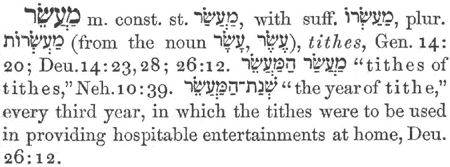
Something that is interesting to note is that the tithes in the Old Testament are always edible, and never monetary. This is not due to the lack of a currency, or because the Israelites were an agrarian people, but because the tithe was to take care of the priests, Levites, and the poor, widows, and fatherless. Food, wine, and oil was over and above more important to someone struggling to survive, or with no inheritance, than gold or silver. The Levites would have the ability to sell some of the excess for coins, but this was not commonplace. The tithe was not a salary for the priests, nor was it for the improvement of the tabernacle/temple. It was strictly for the physical well-being of the intended recipients. When there was a “building project” or a need to be met for the edification of Yahweh’s people, they would give offerings voluntarily (Exodus 25:2-4; 2 Chronicles 24:8-11; Acts 4:32-37).
Is the Tithe Still Applicable?
The presentation made by Paul clearly establishes the point that the Old Covenant Law, the Mosaic Law, had authority over the believers. But now through the death of Christ this Mosaic Law has been canceled as the principle of authority over the saint.
(Sherlin)
Dispensational theologians worldwide would agree with Dr. Sherlin that the Mosaic Covenant is not binding to anyone who is a believer post-Pentecost. They will maintain there is one exception, and that being the “moral law,” which is an extra-biblical term for the parts of the Law which seem to be unchanging, natural law (such as the 10 Commandments, et al). If that be the case (and I say “if” because I am not sold on either Dispensational or its counterpart Covenant Theology), where does tithing fall? Is it a moral obligation? If so, why does a specific commandment to Israel, to tithe off the firstfruits of the land of Israel, apply to Gentile believers in the twenty-first century, while another specific commandment to Israel, to rest the land of Israel every 7 years, does not apply to the same Gentiles? Did not Yahweh judge and punish Israel for failing to rest the land as well as failing to honor the tithe? Why does one apply to us and not the other? We have to be careful to not arbitrarily dismiss some of the commandments and cherry pick others for our own theology and tradition.
Returning to Malachi 3, let’s look at verse twelve. “And all nations shall call you blessed: for ye shall be a delightsome land, saith the Lord of hosts.” Is this a promise for the United States? Or is it for Brazil, Ireland, or Zimbabwe? The text is quite clear that this is a promise for the nation of Judah, and specifically the remnant that returned from Babylonian exile with Ezra and Nehemiah. If one can understand that this part of the promise is for Judah only, how can we conclude that the curse as well as the preceding blessings are for us all? It does not make any sense to single out some for application and others for non application.
So if the tithe was commanded for Israel, to tithe of the fruits of their land, to be given to the Levites in order to feed the priests, widows, fatherless, and poor, is it still a commandment for believers from the first century onward? Strictly speaking of commandments, I conclude that it is not. However, this does not mean that Yahweh cannot or does not give us some of the blessings associated with voluntary offerings, such as described in Malachi. He blesses whomever He chooses to, so He is not bound to only bless those He promised blessings to. If He wishes to “open you the windows of heaven, and pour you out a blessing, that there shall not be room enough to receive it,” then He is sovereign to do so. But He is in no way obligated to extend to us the blessings He promised an elect few, in a land far away, in a time far gone.
Many have said they have found Yahweh’s blessings in their faithfulness to tithe, and they can do more with the 90% they retain than they could if they kept 100% of their income. I do not deny them that claim, for I understand it quite possibly can be true. 2 Corinthians 9:6-8 makes it obvious Yahweh is pleased when we give freely and cheerfully, “But this I say, He which soweth sparingly shall reap also sparingly; and he which soweth bountifully shall reap also bountifully. Every man according as he purposeth in his heart, so let him give; not grudgingly, or of necessity: for God loveth a cheerful giver. And God is able to make all grace abound toward you; that ye, always having all sufficiency in all things, may abound to every good work.” Notice the theme in Paul’s letter to the Corinthians: bountifully, as he purposeth, cheerful. It is our giving from love that matters, not from obligation or fear of a curse. In fact, in another letter, this one to the believers in Galatia, Paul insists that we are free from the curse of the law. “Christ hath redeemed us from the curse of the law” (Galatians 3:13) Furthermore, nowhere in the entire New Testament does the text indicate that Yahweh curses believers. How can He curse someone who is freed from the curse of the Law and the curse of sin?
“All therefore whatsoever they bid you observe, that observe and do; but do not ye after their works: for they say, and do not. For they bind heavy burdens and grievous to be borne, and lay them on men’s shoulders; but they themselves will not move them with one of their fingers. But all their works they do for to be seen of men: they make broad their phylacteries, and enlarge the borders of their garments,” (Matthew 23:3-5)
The Pharisees (and many modern religious preachers and teachers) place heavy burdens on the people, but Jesus says, “For my yoke is easy, and my burden is light.” (Matthew 11:30)
In American culture, we desire to have pastors who can be on call 24/7, preach three times a week (or more), provide counseling, weddings, funerals, and other ministerial functions pro bono. This is above the requirement in Scripture to have the ability to teach. If we demand a pastor that is available, we have to be willing to pay him appropriately so he can be set aside for the work of the assembly and also provide for his basic needs as well as that of his family. Our culture today demands so much financially that it usually works best if the church has a set salary and a steady offering that allows for this kind of financial stability, and that is something most pastors also desire. While this is not the model we see in Scripture, I would be presumptuous to say it is unbiblical. To take weekly offerings for the maintenance of the building, the pastor’s salary, benevolence, and other needs of the assembly is perfectly appropriate and necessary. Furthermore, we’ve already seen that Yahweh loves a cheerful giver, and is not afraid to bless one who gives from the heart. But we err in believing, and more seriously in teaching that the tithe is a commandment for the New Testament believer with a curse for one who “robs God” by withholding 10% of their income.
Works Cited
Ansa, Owusu. “You are Cursed if You Don’t Pay Tithe.” GhanaWeb, 5 November 2013, https://www.ghanaweb.com/GhanaHomePage/NewsArchive/You-are-Cursed-if-You-Don-t-Pay-Tithe-291103. Accessed 3 October 2022.
IndependentBaptist.com. “Why Tithing Is Still For The New Testament Church.” IndependentBaptist.com, https://www.independentbaptist.com/tithing-still-new-testament-church/. Accessed 3 October 2022.
Sherlin, Keith A. “The Law of Moses or the Law of Christ?” Essential Christianity, http://www.essentialchristianity.com/20617. Accessed 4 October 2022.
 The Objective Perspective