
“Be sure you’re right, then go ahead”
Davy Crockett (maybe)
This quote was uttered by Fess Parker in his portrayal of the legendary Davy Crockett in the 1955 Disney film Davy Crockett: King of the Wild Frontier. While it is unknown if the actual Crockett spoke that mantra, it is nonetheless good advice. It is a maxim I have lived by my entire life, although not with the greatest of results. Simply put, sometimes I am wrong. Gravely wrong. And when I am made aware of my fallacy, I try to set pride aside and admit it. On the other hand, when I have searched the facts and my heart and sought the Holy Spirit’s guidance and confirm I was not wrong, I have no other choice but to affirm my stance or belief, until convinced otherwise. This article will address both sides of the coin.
Since 2015, I have been repeatedly called to account for my embrace of Southern heritage, namely, the Confederate battle flag and memorializing the soldiers who carried that banner. I became a member of the Sons of Confederate Veterans in 2016 and quickly became a leader in the organization. I championed the cause of heritage and history and have fiercely defended the Confederate soldier’s name and purpose. My interest in such things are much older than three-quarters of a decade though. I whetted my appetite for history over three decades ago as a schoolboy and had a burning desire to understand not only American history, but my family’s history. The more I researched, the more I uncovered about our involvement in every major American conflict and historical event stretching from colonial Virginia to the Republic of Texas. From the Atlantic to the Rio Grande, we had our hands in the dirt, building a home in the New World. My family bought land from and lived among the Creeks, Chickasaws, and Choctaws and some intermarried. With the exception of a few distant cousins or uncles, none of our success was won on the backs of slaves. Indeed, there is no generational wealth at all, let alone any that can be traced to the institution of slavery. We were all farmers, shopkeepers, and pioneers, but not slave-owners. However, when the southern states began to secede from the voluntary union that was known as these United States, the need for an army arose and across Texas, Arkansas, Mississippi, and Alabama, my kinfolk answered the call. Some died of disease, others served in the entire war, and yet others were discharged or deserted. All suffered immensely. We possess no written sources that describe why they enlisted. Was it for wanderlust, seeking adventure? Maybe it was a sense of duty that drove them to the recruiting stations. Perhaps it was guilt, not wanting to be ashamed for staying behind. Others could have been compelled, facing conscription or being treated as a traitor. Lastly, some may have been concerned that their way of life, coexisting with the “peculiar institution” of slavery was in jeopardy. I simply do not know why they fought and died for the Confederacy. Frankly, I do not lose sleep over it. Worse (according to my detractors), I ardently and affectionately honor my ancestors without shame. And this is what brings us to the mantra noted above.
Recently I was engaged on Twitter with an old friend whom I’ve known for over fifteen years. We’ve disagreed since the beginning about the Civil War and the Confederacy specifically. At one point, he told me “you are the only non-racist Confederate I’ve ever met,” a point I took as a compliment, but by surprise because I’ve known many like-minded southerners in my day. But as a black man, I’m sure his experiences have been much different than mine. Nonetheless, we’ve maintained a friendship over the years and I have been very forthcoming in my conversations with him about race and history, even asking him how I can better understand the struggle of black people in America, especially during the summer of George Floyd. Again, I was trying to search to see if I was wrong in how I viewed this conflict. However, during our most recent interaction, he sent me a tweet that showed me how misunderstood I am, or how I come across to others. Due to that tweet, I decided to write this short post.
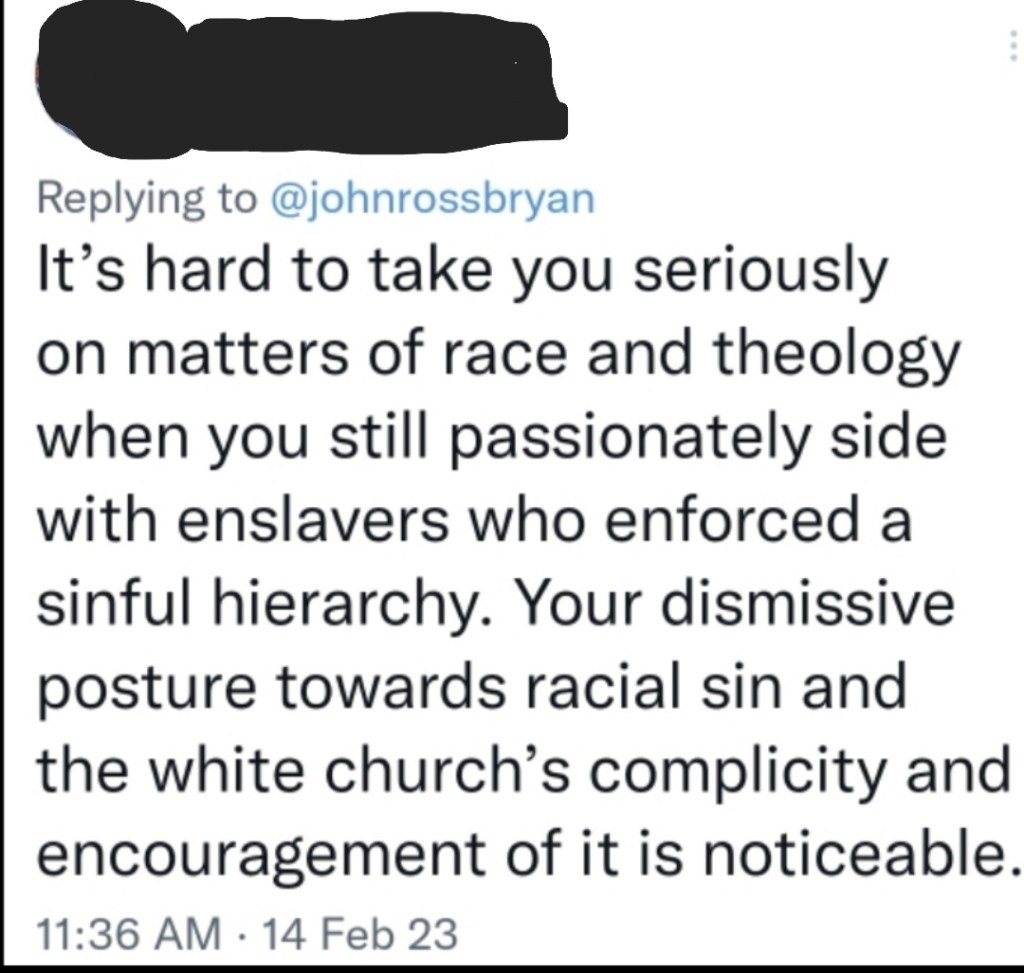
I have been wrong. In the past, in my enthusiasm to defend the south and my ancestor’s names, I have dismissed their involvement in the perpetuation of slavery. As I’ve already noted, they did not participate in slavery, but did they enable it? One could say they did by their alliances with the Confederacy. Without getting deep into the sundry causes of the Civil War – and there are many causes for the war – an inexplicable fact is one of the reasons was to fight against the abolitionist Republican Party and it’s goal of ending slavery and expanding free soil all the way to the Pacific. Not every secession convention noted preservation of slavery as a cause, but most Democrats supported slavery, and most secession conventions were made up of Democrats. Interestingly, most southern apologists today insist that the states seceded over state’s rights and the adherence to the Constitution, and that is one hundred percent correct. The constitution in 1860 protected slavery and the interests of slaveholders. To force a state to abolish slavery would have been a violation of the Constitution, thus the invasion would have been unconstitutional and illegal. So while defending slavery was morally reprehensible, it was completely legal and every southern American knew that. Furthermore, if the Federal government or another state could compel a slave state to bend to their will, what else would they coerce them to do? Could Minnesota then force Alabama to vaccinate it’s population because of a “moral good?” The slope is very slippery. So rather than risk being run roughshod over in the halls of Congress, the southern states chose to create their own legal system that protected their own interests and defended by the might and blood of my ancestors. Right, wrong or indifferent.
I have been right. The average southern soldier had little to say about the opinions of the fire-breathers who called for secession and war, but overwhelmingly speak and write about fighting for home and family. In truth, many modern warriors have spoken of fighting for their brothers-in-arms, the men that are beside them in battle. Few veterans that I’ve spoken to had much to say about the politics that sent them to war, be it World War II, Vietnam, Iraq and Afghanistan, or any other. When they do, it’s often with disdain. The politics surrounding the last several conflicts America has inserted itself in have been immoral, thus the cause was as well. This does not mean that we are sinning by showing respect to the men and women who carry our nation’s flag in battle. Indeed, many people who have criticized me for honoring my Confederate ancestors because they fought for a nation that institutionalized slavery have sworn to protect and uphold the Constitution of a nation that invades other sovereign nations and until very recently protected and legalized wholesale abortions to the tune of more than one million per year since 1973. During that time span, I have had many friends and family members who served in the Armed Forces. My great-grandfathers served in World War II during a time our nation imprisoned Japanese and German immigrants because of the language they spoke or their appearances. I continue to pay honor to them for their services, especially those who sacrificed so much in combat. They joined willingly because it seemed to be the right thing to do, not caring about the politics of the politicians, but wanting to serve their country and defend their family. Right, wrong or indifferent.
Bottom line is, chattel slavery such as was practised in Great Britain and the Americas was wrong. Anyone who supported it was wrong in doing so. Fighting against something that is wrong is always good, if it is done righteously. As the old adage says, two wrongs don’t make a right, so let’s be clear: the northern abolitionists who called for the death and pillaging of the south and it’s people were also very wrong. General Sherman said “War is hell,” and General Lee said “It is good that war is so terrible, lest we grow too fond of it.” Unfortunately for the people of the South, Sherman was much too fond of it and, with President Lincoln’s permission, unleashed upon the South hoards of soldiers who also were very fond of it. Ultimately though, I believe Almighty God is sovereign in all things, and it was His will that the South met defeat. Perhaps the Civil War was judgement on the nation for perpetuating slavery and other ills. Maybe it was because in His foreknowledge He knew the country needed to be united for future mutual benefit. Could be that there is still something to come that He knows can be best accomplished through circumstances that were only possible if the Confederacy was defeated. I don’t know the reasoning, but I trust His will. I also regret that slavery ever contaminated the land mass that my ancestors and I have called home for nearly four hundred years. Finally, I am grateful that the DNA of warriors and brave men and women exists within me today. Right wrong or indifferent.


 The Objective Perspective